
Active Constructive Responding (ACR)
getting better at good news



Ever share good news, and the room goes quiet? A flat response can pull the air out of the moment, making us slow to share the good stuff.
It’s happened to all of us. Sometimes we’ve been “that friend” who had a floppy response to someone’s joy.
Unfortunately, these joy fumbles can cause major stress in a relationship. At work, they leave us feeling isolated, self-protective, undervalued. We learn to guard our good news and keep more than our weaknesses hidden. At home the damage can feel even more personal.
Even beyond the impact to our relationships, moments of joy are crucial for nourishing our cells, strengthening our resilience, and enriching our quality of life day-to-day. Research shows that expanding our experience of positive emotions broadens and builds us up.1
Today at the Pawsitive Psych Digest we’re tackling this because in a world of stress and pressure, one way to improve our quality of life is to make a bit of elbow room for the already-good stuff around us. If we don’t do this on purpose—or develop communication habits like active, constructive responding—our attention will be drawn to negativity.
There are good reasons why we develop this negativity bias. Some other time, we might explore how negativity bias is helpful and useful for avoiding problems (and for preparing ourselves to fix them). But not today.
Today, we want to explore a simple communication technique that boosts your well-being and deepens connections into rewarding, psychologically safe connection points for living a flourishing life.
Here on the Pawsitive Psych Digest we look at applications of positive psychology — ways we can use the science of positive emotion to improve our life’s adventure. And it turns out there is exciting research demonstrating the effectiveness of a communication technique we all can use to get more happiness and connectedness out of everyday moments.2
The technique is called Active Constructive Responding.
ACR: Active Constructive Responding
The term Active Constructive Responding comes from a response-style quadrant that includes:
Active-Constructive Response
Passive-Constructive Response
Active-Destructive Response
Passive-Destructive Response
Of the four response types, only ACR deepens connection and amplifies positive emotions. In the original study, researchers targeted partner responses to positive news (so, how did a spouse handle it when their partner shared something good) . Whether something as simple as a good day at work or as significant as a major promotion, how people respond to our positive emotions can be either active or passive, constructive or destructive. The impact of their choice on us is significant.
Active Not Passive
Whether it’s good news or bad, an active response from others means they turn their attention and energy to us to engage. Things like eye contact, body language, and focused attention are active. It’s not surprising that this kind of response makes us feel valuable or helps us feel more seen by and connected to the person who responds this way.
For some of us, an active response to our happiness means a huge smile, a big hug, or running across the room to jump in the air. But it can be just as powerful to gently put down whatever you were focused on and quietly give your full attention to someone.
In a busy setting where everyone is multitasking, making an active response to good news is tougher. A strong, active response in a setting where you can’t drop what you’re doing to focus on the other person usually means putting excitement into your voice and bringing the appropriate level of “Wow” or “That’s amazing” sort of energy so they feel you responding to the message they’ve shared.
Constructive Not Destructive
The “constructive” part of an Active Constructive Response means trying to BUILD ON what was shared. In particular, helping your conversational counterpart build on what was shared in the direction they’ve chosen. (As we’ll see, it’s really important that THEY are the ones to build on it. It doesn’t help if WE build something on their news.)
For example, if my sister tells me her Goldador Fitzgerald was so happy today during training, my response is constructive if it invites her to tell me more about that experience. It’s not constructive if I tell her how great my day was, or ask her question about next week’s schedule.
It’s not even constructive if I tell her “Good job, I’ve made your favorite stew to celebrate!”
The whole point is to invite her to build on what she shared. If I don’t do that (even if I praise her!), I haven’t let her enter into and experience her joy more.
The destructive response can be benign or well-intentioned (e.g., praising someone rather than inviting them to share more). But it can also be surprisingly inconsiderate. Like when someone says they have the morning off, and we say “Wow I wish I had the morning off.” Or when they tell you they checked things off their list, and you rehearse your own open loops.
You don’t have to be a monster to be a destructive responder.
But when you do it, you actually are destroying something.
There’s something magical in that hopeful, excited space that arrives with a finished task, some good news, or a positive change. There’s room to build on the good, or even just to enjoy it a tiny bit longer before the moment leaves. (Researchers call this “capitalizing” the good event, so we can think about it like building joy capital by investing the seed of the good thing back into our lives by sharing and engaging it.)
When we’re navigating anxious feelings, sadness, discouragement, or seasons of uncertainty, even micro-moments of positive emotion can nourish and refresh us to build our inner resources. Joy strengthens us to keep doing the work of reshaping our chaotic world.
We can all get better at this. So tag a Wild + Brave buddy, and team up to work on your Active Constructive Responding skills.
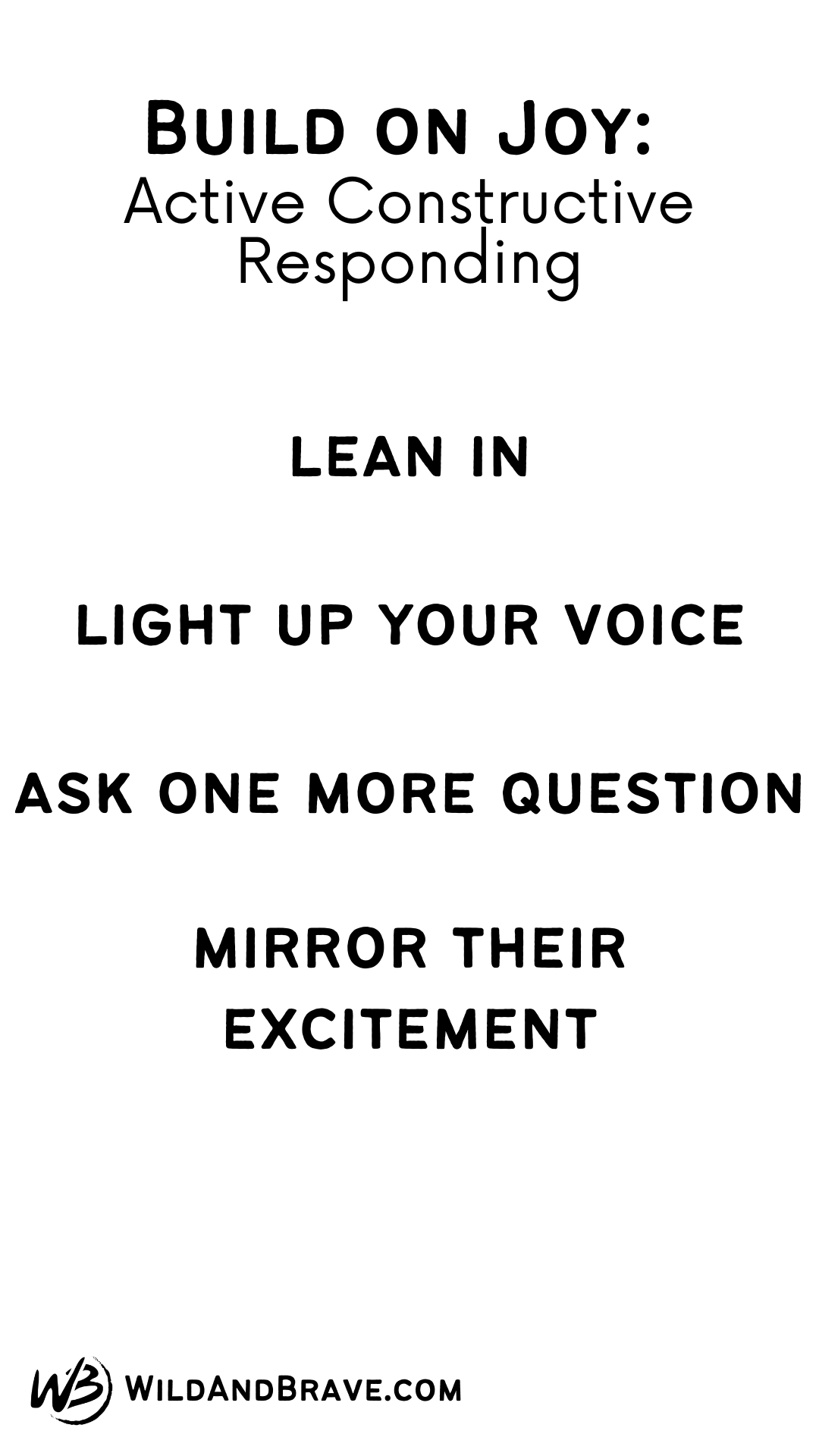
Experiment with being a bit more ACTIVE:
Give more of your attention and energy to the person who is talking to you. Take the willingness you have to be excited for them, and push it all the way up into your face, shoot it out your arms, and let their happiness bounce through you on its way back to them.
Notice where DESTRUCTIVE responses have crept in:
The question isn’t whether you give destructive responses. We all do. So give yourself (and maybe a friend) permission to notice where your responses are actually destructive. Don’t change the subject, or hijack the joy, or just give praise and head back to what you were doing before. Take a tiny moment to invite your counterpart to build on what they shared.
Set a CONSTRUCTIVE goal:
When I’m trying to strengthen my Active Constructive Responding skills, I like to set a little goal for myself. For example, before I add in my story, or ask other questions, or even switch to praise, I’ll try to get three new pieces of information about the good thing. This might be a couple of questions, or simply an “oh tell me about it!” and listen with big ears and smile. Sometimes I’ll pretend I’m a journalist and look for some “who, what, where, when, and how” about the situation. If this is a new technique for you, consider aiming to add one invitation to build on what they’ve said and see where it goes.
Learn more about this research on how positive emotions nourish our cells from Dr. Barbara L. Fredrickson, PhD. and her Broaden and Build Theory of Positive Emotions.
Her book Positivity: Discover the Upward Spiral That Will Change Your Life will walk you through the clinical research and implications for life that positivity states can have on us. And her book Love 2.0: Creating Happiness and Health in Moments of Connection shares clinical research on how cultivating positivity resonance can measurably impact cellular regeneration (i.e., reversing cellular age!).
Learn more about psychologist Shelly Gable’s research process and results exploring how people cope with good news, in “What do you do when things go right?”
Gable, S. L., Reis, H. T., Impett, E. A., & Asher, E. R. (2004). What do you do when things go right? The intrapersonal and interpersonal benefits of sharing positive events. Journal of Personality and Social Psychology, 87, 228-245.
Great insights, thanks for sharing! I definitely plan to use this information.